
Protected since 1993
Cape Greco has been a State Forest since 1993 and is part of the EU Natura 2000 network. The pine and juniper forest shelters rare orchids and hosts over 400 migrating bird species.
Travel guide · Ayia Napa, Cyprus
The most spectacular stretch of coastline in eastern Cyprus — a protected national park of white limestone cliffs, sea caves and the famous Blue Lagoon. A complete visitor guide, and a premium private Mercedes transfer to get you there.
Introduction
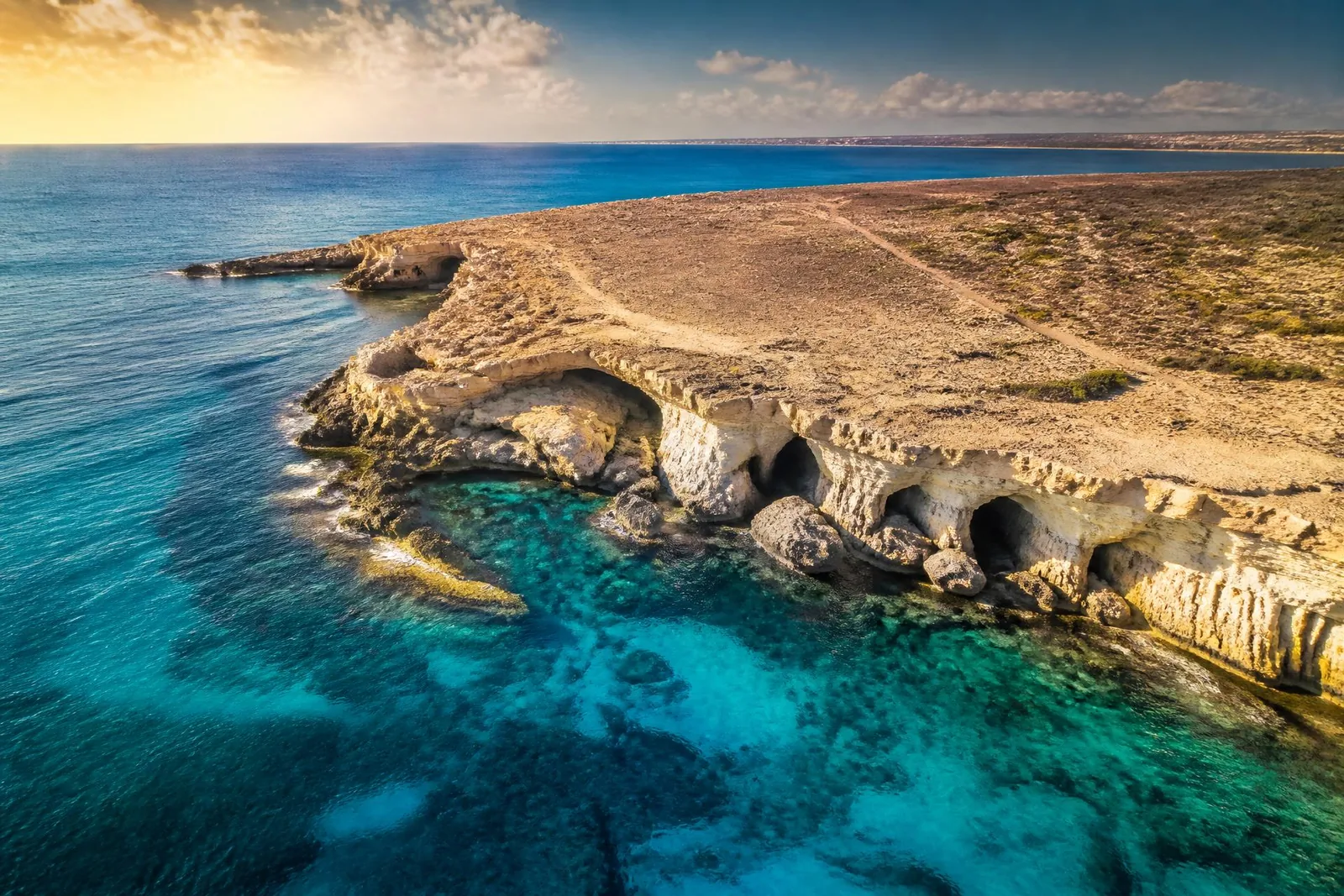
Cape Greco sits on the south-eastern tip of Cyprus, a rocky headland between Ayia Napa and Protaras where pine forest meets white limestone cliffs and water so transparent it looks artificial. The 385-hectare Cape Greco National Forest Park protects sea caves carved by millennia of waves, the famous Blue Lagoon swimming spot, the whitewashed Agioi Anargyroi chapel and one of the best sunset viewpoints in the Mediterranean. Entry is free, year-round and 24 hours a day — and yet the park feels remarkably uncrowded compared with the beaches just minutes away.
About the park
Cape Greco has been a State Forest since 1993 and is part of the EU Natura 2000 network. The pine and juniper forest shelters rare orchids and hosts over 400 migrating bird species.
Soft limestone cliffs eroded over thousands of years into arches, pillars and the famous sea caves — the geological heart of the park and a magnet for cliff-jumpers and photographers.
Local folklore places a sea monster, the 'Ayia Napa Ayia' (the Friendly Monster), in these waters. On the headland sit two whitewashed chapels and the Greek flag pole — a classic Cyprus sunset shot.
Blue Lagoon
On the northern flank of Cape Greco lies the Blue Lagoon — a sheltered cove of electric-turquoise water framed by low limestone cliffs. There is no sandy beach: you arrive by boat from Ayia Napa or Protaras harbours, or hike down from the cliff-top road and swim straight off the rocks. The water is glass-clear, deep enough for snorkelling and warm from May to October. Cliff-jumpers leap from heights of 3 to 8 metres — popular but always at your own risk; check depth and currents first.
Several daily cruises leave Ayia Napa and Protaras harbours from April to November.
Park at Konnos viewpoint and walk 10 minutes down the marked trail to the rocky entry point.
Sea Caves
Between Ayia Napa and Cape Greco, the cliffs are riddled with sea caves — natural arches, pillars and tunnels carved by Mediterranean waves over thousands of years. The most famous viewpoint is signposted "Sea Caves" off the main coastal road, with a small free car park at the top and a short cliff-top path leading to the photo spots. The deeper caves are best reached by boat or kayak from Ayia Napa harbour.
Best sunset viewpoints
A panoramic balcony above Konnos Bay with the cape, the sea caves and the open Mediterranean in one frame. Easy to reach by car.
A whitewashed Byzantine chapel on a rocky promontory above a small sea cave. The classic Cape Greco sunset photograph.
The actual cape — the easternmost point of the park, with the Cypriot flag, a 360° horizon and the most dramatic golden-hour light.
Arrive 30 minutes before sunset, bring water and a light jacket — the cape is exposed and breezy in the evening.
Hiking & cycling
The European E4 long-distance footpath crosses Cape Greco. Shorter waymarked loops connect Konnos Bay, the Sea Caves, Cyclops Cave, Agioi Anargyroi chapel and the cape itself — from 30-minute strolls to a full half-day hike. Mostly flat, very little shade.
A signed cycling route loops the headland on quiet park roads and dirt tracks — about 12 km in total, suitable for hybrid bikes. Rentals are available in Ayia Napa and Protaras. Early morning is coolest; bring at least one litre of water per rider.
Photography tips
Late afternoon and the hour before sunset. Morning light bleaches the cliffs; midday is harsh and white.
A 16–35 mm (or 0.5× phone lens) captures both the arch and the lagoon in one frame at the sea caves.
A 70–200 mm compresses the chapel against the cliffs at Agioi Anargyroi — the iconic Cape Greco shot.
Drones are restricted in parts of the national park and near the British base. Check current rules with the Cyprus Department of Civil Aviation before flying.
How to get there
The main entry points are the Konnos Bay car park, the Sea Caves car park and the Cape Greco flagpole — all free and signposted off the Ayia Napa–Protaras coast road. The park is open 24 hours, free of charge.
Skip rentals, parking and bus timetables. We pick you up at the airport or any address in Cyprus — Larnaca, Limassol, Ayia Napa, Protaras, Paphos, Nicosia — in a spotless Mercedes E-, S- or V-Class, drop you at Konnos, Sea Caves or the cape, and wait while you explore. Fixed pricing, 24/7, child seats included.
Nearby attractions
Cyprus' most famous beach — powder-white sand, shallow turquoise water and the iconic Nissi islet, 15 minutes west of the cape.
Read guide →A blue-flag bay in Protaras with calm shallow water and a small offshore island — one of the most photographed beaches in Cyprus.
A picturesque fishing port with glass-bottom cruises, seafood tavernas and the 16th-century Ayia Napa Monastery.
Why us
Spotless Mercedes E-Class, S-Class and V-Class with leather interiors, climate control and professional chauffeurs.
No shared shuttles, no detours. Your car, your schedule, door-to-door from any address in Cyprus.
Licensed, English-speaking drivers who know every viewpoint, beach and back road around Cape Greco.
We track your flight in real time. Early or delayed — your driver adjusts automatically, free of charge.
Sunrise photography trips, late-night airport pickups, weekends and holidays — we drive every day of the year.
Quoted at booking, paid on arrival. No surge pricing, no surprises — cash, card or Revolut.
Baby, child and booster seats supplied at no extra charge — just tell us your child's age at booking.
FAQ
Continue planning
Book your transfer
Send your pickup address, date and time on WhatsApp or Telegram. We confirm within minutes — fixed price, 24/7.